
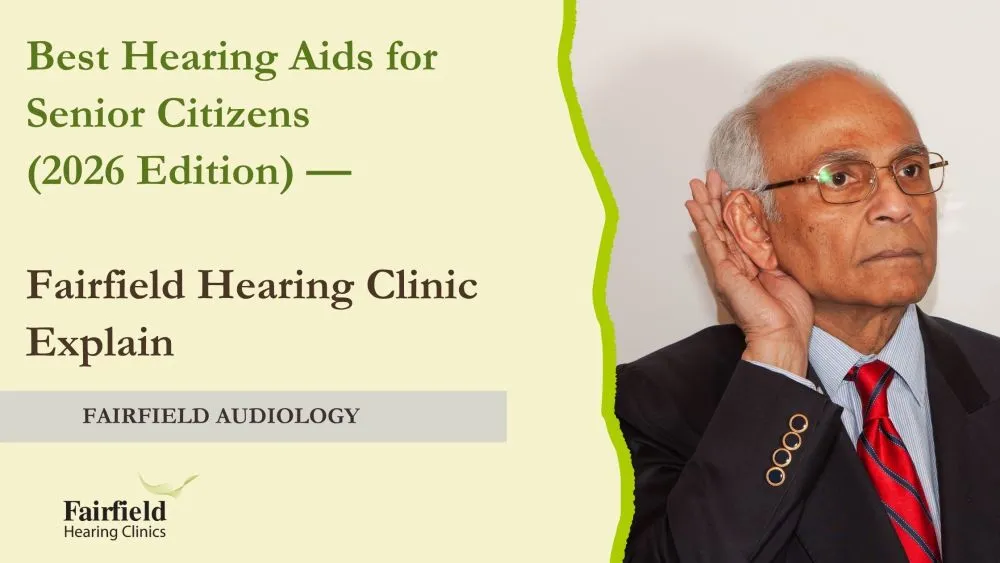
Which hearing aid is best for senior citizens and elderly parents?
For most senior citizens, the best hearing aid — and the best value — is an entry-level or mid-level hearing aid from a major brand, in an easy-to-handle style such as receiver-in-canal (RIC) or behind-the-ear (BTE), rechargeable if the budget allows, fitted after a proper hearing test and tried at home before you pay. At Fairfield Hearing Clinics, entry-level hearing aids from major brands start at an MRP of about ₹27,000 per hearing aid (one ear), and rechargeable models start at about ₹33,000 per ear (November 2026). A well-fitted entry model helps far more than an expensive one that sits in a drawer because it is hard to use.
The lowest and highest MRP per ear for each brand we fit, updated from our live price list:
| Brand | MRP per ear | Styles | Models & variants |
|---|---|---|---|
| Signia | ₹10,990 to ₹6,00,000 | BTE, Custom (in-ear), RIC / RIE | 227 · Signia prices |
| Phonak | ₹33,000 to ₹4,55,500 | RIC / RIE, BTE, Custom (in-ear) | 58 · Phonak prices |
| ReSound | ₹21,995 to ₹4,99,995 | BTE, RIC / RIE, Custom (in-ear) | 113 · ReSound prices |
| Widex | ₹23,990 to ₹4,31,000 | BTE, Custom (in-ear), RIC / RIE | 159 · Widex prices |
| Unitron | ₹37,000 to ₹3,23,000 | RIC / RIE, BTE, Custom (in-ear) | 53 · Unitron prices |
| Bernafon | ₹26,990 to ₹4,24,990 | Custom (in-ear), RIC / RIE, BTE | 99 · Bernafon prices |
Prices shown are the MRP (maximum retail price, inclusive of all taxes) for one hearing aid (one ear) unless stated. Your final price is confirmed in writing after your free hearing test.
Special price Attractive offers on MRP are available at Fairfield — ask us for your best price.
What matters most in a hearing aid for an older person?
For an older person, ease of use matters as much as sound quality. The features that make the biggest difference are:
- Easy handling: a rechargeable hearing aid removes tiny batteries, which are hard for stiff fingers and weak eyesight. A slightly larger RIC or BTE is easier to put in than a tiny in-canal model.
- Clear speech: the hearing aid must be programmed to your parent’s hearing test, so voices are clear without being too loud.
- Simple controls: one button, or none — modern hearing aids adjust automatically. A phone app is useful only if your parent, or someone at home, will use it.
- TV and phone: many hearing aids can stream the phone and, with a small TV adapter, the television straight into the ears.
- Aftercare nearby: a clinic close to home, or home visits, for cleaning and adjustments.
Very small invisible hearing aids look discreet but are often hard for older people to handle and clean. See invisible hearing aids for when they suit.
How much do hearing aids for elderly parents cost?
Hearing aids for elderly parents usually cost, as MRP per hearing aid (one ear) on our price list in November 2026:
| Level | MRP per ear (examples) | Good for |
|---|---|---|
| Entry | about ₹27,000 to ₹45,000 — e.g. Signia Intuis 3 (₹26,990), Phonak Terra (₹33,000) | Quiet home life, TV, family conversation |
| Entry rechargeable | about ₹33,000 to ₹80,000 — e.g. Signia Orion Charge&Go RIC 50 (₹32,990), Phonak Terra+ RIC-R (₹62,000), Signia Pure Charge&Go 1IX (₹77,990) | Parents who find batteries difficult |
| Mid level | about ₹1,00,000 to ₹1,50,000 — e.g. Phonak Audéo I30-R (₹98,000) to I50-R (₹1,49,000) | Social life, religious gatherings, functions, outings |
| Premium | above ₹2,00,000 | Very active, noisy surroundings |
For both ears, see the pair prices on the hearing aid price list. Your price is confirmed in writing after the hearing test. Most elderly parents who are at home most of the day do very well with entry or mid-level technology.
Does my parent need two hearing aids or one?
Most older people with hearing loss in both ears hear better with two hearing aids: speech is clearer in noise, and it is easier to tell where sounds come from. If the budget allows only one at first, ask the audiologist which ear will benefit more, and add the second later. One good hearing aid, well fitted, is better than two cheap amplifiers.
Is a cheap “hearing machine” from the market good enough for my parent?
No. A cheap “hearing machine” sold online or at a chemist is usually a sound amplifier: it makes every sound louder but is not set to your parent’s hearing, so speech is often no clearer, and loud sounds can be uncomfortable. It also usually has no proper warranty or service. Read our hearing aid price guide and how to check a hearing aid is genuine before you buy.
Is there any government help for hearing aids for senior citizens?
Yes, depending on your parent’s situation:
- CGHS: central government pensioners and other CGHS beneficiaries can claim up to ₹30,000 per ear for hearing aids, under the Office Memorandum of 9 September 2026 [1]. See our CGHS hearing aids guide — we help with the paperwork.
- Rashtriya Vayoshri Yojana (RVY): a central scheme that gives free aids, including hearing aids, to senior citizens aged 60 or over whose income is not more than ₹15,000 a month, through camps run by ALIMCO, the government’s implementing agency [2]. The hearing aids given are basic models.
- ADIP scheme: for people with a disability certificate, the Department of Empowerment of Persons with Disabilities funds hearing aids in full for a monthly income up to ₹22,500, and half for an income up to ₹30,000 [3]. Check its current status with your district office.
- Health insurance: most policies do not pay for hearing aids unless the policy says so [4] — see warranty, loss cover and insurance.
Can we pay in instalments?
Yes. At Fairfield you can pay through Bajaj Finserv EMI over 3, 6, 9 or 12 months, with no-cost EMI on selected tenures, subject to approval; a one-time processing fee applies. Bajaj’s EMI Card is for applicants aged 21 to 70, so a working son or daughter can take the EMI for a parent who is older. Read hearing aid EMI: the total cost explained.
Can my parent have the hearing test at home?
Yes. Fairfield does a free home hearing test anywhere in Delhi NCR, with no visit charge — useful for parents who are unwell, have limited mobility or do not like travelling. An RCI-registered audiologist brings a portable audiometer and explains the results to the family. Book a home hearing test.
How do I help my parent get used to hearing aids?
To help a parent get used to hearing aids, encourage them to wear the hearing aids every day, starting with a few hours at home and increasing slowly; speak clearly and face them, without shouting; and keep the follow-up appointments, because the first adjustments make the biggest difference. Everyday sounds such as fans and footsteps can seem loud at first; this usually settles within a few weeks. Read getting used to new hearing aids and hearing loss and dementia.
What should I check before paying for a parent’s hearing aid?
Before you pay, make sure you have:
- a hearing test report (audiogram) and a recommendation you understand;
- a written quote per ear and for the pair;
- a home trial — at Fairfield, 3 days, extendable up to 7;
- an invoice with the serial number of each hearing aid and the warranty card;
- a clear aftercare plan — at Fairfield, 2 years of free check-ups, cleaning and fine-tuning.
References
[1] Ministry of Health & Family Welfare. CGHS Office Memorandum No. S.11030/76/2026-EHS dated 09-09-2026 (hearing aids). Explained in our CGHS hearing aids guide.
[2] Outlook Money. Income below Rs 15,000? Get free assisted-living devices under Rashtriya Vayoshri Yojana (18 August 2023) — eligibility (60 years or older, monthly income not more than ₹15,000), devices including hearing aids, ALIMCO as the implementing agency. outlookmoney.com
[3] Department of Empowerment of Persons with Disabilities, Government of India. Scheme of Assistance to Persons with Disabilities for Purchase/Fitting of Aids/Appliances (ADIP). depwd.gov.in
[4] Insurance Regulatory and Development Authority of India — standard list of non-payable items, as published by Care Health Insurance (hearing aids payable only if allowed in the policy). careinsurance.com (PDF)