
If your hearing has dropped suddenly - read this first
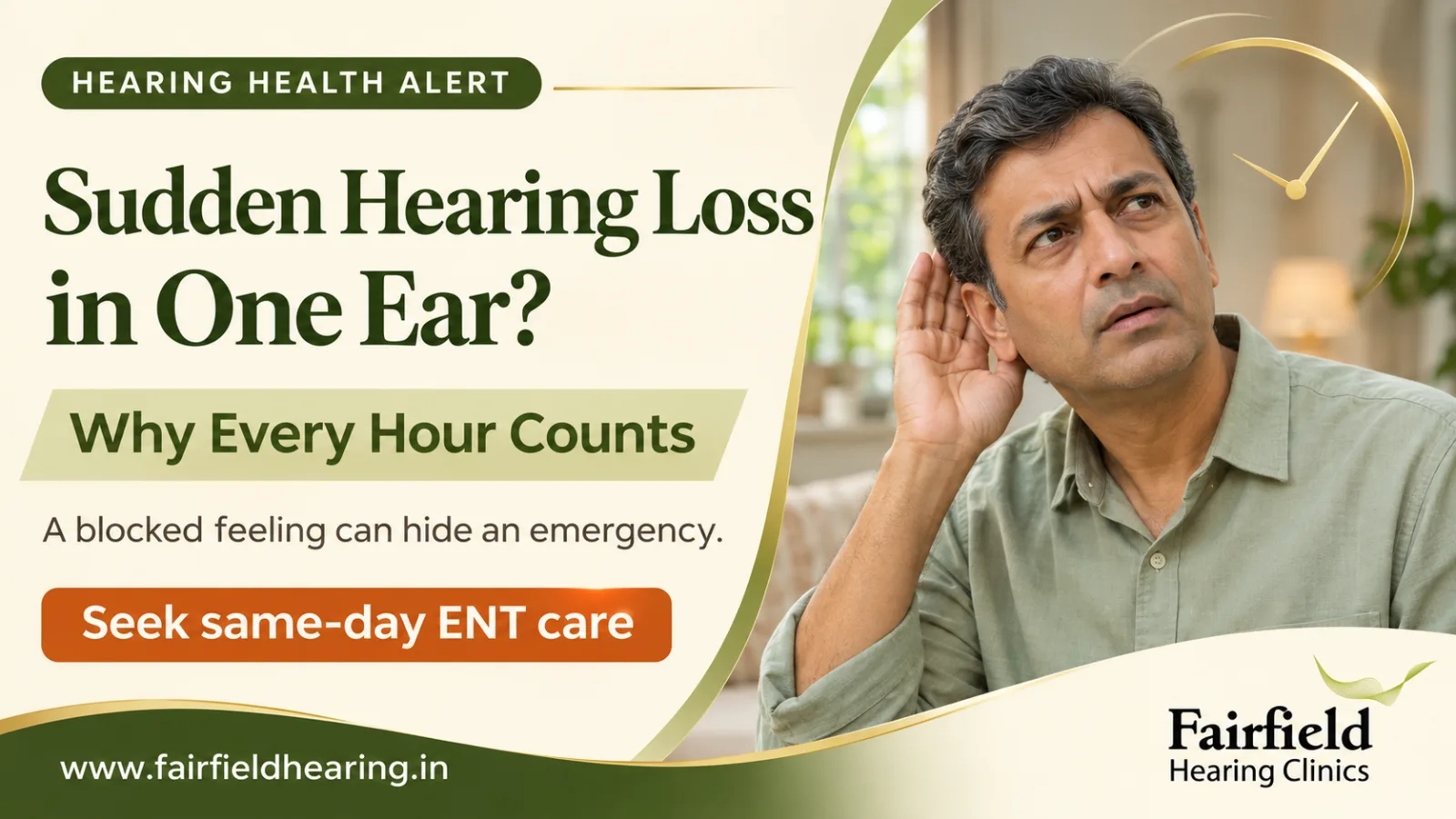
Sudden hearing loss is a medical emergency - get medical help the same day. See an ENT doctor or go to a hospital emergency department today. Do not wait to see if it opens up on its own, and do not put oil or drops in the ear.
Call 112 immediately if hearing loss comes with a drooping face, weakness in an arm or leg, slurred speech, double vision or severe unsteadiness - these can be signs of a stroke.
1. What is sudden hearing loss?
Sudden hearing loss is hearing loss that develops within 72 hours, usually in one ear. Doctors define sudden sensorineural hearing loss as a drop of at least 30 decibels across three neighbouring pitches on a hearing test, developing within three days [1][2].
There are two broad kinds, and telling them apart is the first job of the doctor [1]:
| Type | Where the problem is | Common examples |
|---|---|---|
| Conductive (blocked sound) | Ear canal, eardrum or middle ear | Wax, ear infection, fluid behind the eardrum, perforated eardrum |
| Sensorineural (nerve) - SSNHL | Inner ear (cochlea) or hearing nerve | Usually no clear cause; this is the emergency type |
| Mixed | Both of the above | For example, infection affecting middle and inner ear |
2. Is sudden hearing loss an emergency?
Yes. Sudden hearing loss is a medical emergency - get medical help the same day. Early treatment is linked with better recovery, and ENT guidelines advise starting steroid treatment within the first two weeks [1][2].
The inner ear depends on a single small artery with no back-up blood supply, which makes it very sensitive to damage [2]. Waiting "a few days to see if it clears" uses up the time when treatment is most likely to help. In India, many people first try oil drops or wait for a cold to settle - this delay is one of the most common reasons we see patients too late.
3. What does sudden hearing loss feel like?
Most people notice that one ear suddenly sounds muffled, blocked or "dead" - often on waking or when using the phone. Some hear a pop just before the hearing drops [2].
Blocked or full feeling in one ear, as if water or cotton is inside.
Sounds seem quieter or distorted on one side; voices may sound tinny.
Tinnitus - ringing, buzzing or hissing in the affected ear.
Dizziness or vertigo - present in 30–60% of cases [1].
Noticing it on the phone - many people realise only when they switch the phone to the other ear.
4. How can I tell if it is wax, a cold or nerve hearing loss?
You cannot reliably tell at home - an ear examination and a hearing test are needed. A blocked ear from wax or a cold and sudden nerve hearing loss can feel exactly the same [1][3].
| Clue | More likely wax / cold / infection | More likely nerve (SSNHL) |
|---|---|---|
| Ear pain or discharge | Common | Uncommon |
| Recent cold, flight or swimming | Common | Possible, but not typical |
| Dizziness or ringing | Less common | Common |
| Doctor sees wax or fluid | Yes | Ear usually looks normal |
| Tuning-fork test | Sound louder in the blocked ear | Sound louder in the good ear |
About the "hum test" you may see online: humming and noticing which ear hears it louder is similar to the doctor's tuning-fork (Weber) test. In one clinical series, the tuning-fork test pointing to the good ear was 99% sensitive for nerve-type loss among people whose sound moved to one side [4]. But the home hum test has mainly been validated for conductive (blocked) loss, not as a self-check [5]. Never let a home test delay seeing a doctor the same day.
5. What causes sudden hearing loss in one ear?
In more than 90% of people no definite cause is found - this is called idiopathic sudden sensorineural hearing loss [1][2]. Possible reasons include viral infections, reduced blood flow to the inner ear, inflammation or immune problems.
Less commonly, a specific cause is found, which is why proper tests matter [2]:
Vestibular schwannoma (acoustic neuroma) - a non-cancerous growth on the hearing and balance nerve; found by MRI.
Ménière's disease - especially if attacks of vertigo and fluctuating hearing repeat.
Head injury, sudden pressure change or very loud noise.
Some medicines that can harm the inner ear (ototoxic drugs).
Autoimmune disease, infections or, rarely, problems with blood supply to the brain.
Red flags the doctor will look for: hearing loss in both ears, repeated episodes, or other nerve symptoms such as facial weakness, numbness or trouble walking [1].
6. What tests will the doctor do for sudden hearing loss?
The key tests are an ear examination, a tuning-fork test and a full hearing test (audiometry) as soon as possible, followed by an MRI scan or ABR test to rule out a nerve problem [1].
| What the guideline says (AAO-HNS 2019) | Strength | In plain words |
|---|---|---|
| Distinguish nerve hearing loss from blocked-ear hearing loss at the first visit | Strong recommendation | Examine the ear and do tuning-fork tests straight away |
| Check for both-ear loss, repeated episodes and nerve signs | Recommendation | Look for features that suggest another cause |
| Get audiometry as soon as possible, within 14 days | Recommendation | A proper hearing test confirms the diagnosis |
| Evaluate for retrocochlear causes with MRI or ABR | Recommendation | Rule out a growth on the hearing nerve |
| Do NOT order routine CT scan of the head | Strong recommendation against | CT rarely helps in this situation |
| Do NOT order routine blood tests | Strong recommendation against | Blood tests are only for specific suspicions |
Source: Chandrasekhar et al., Clinical Practice Guideline: Sudden Hearing Loss (Update), Otolaryngology-Head and Neck Surgery, 2019 [1]. MRI with contrast is the preferred scan; ABR is an alternative but misses about 20% of small nerve tumours [2].
7. What is the treatment for sudden hearing loss?
The main treatment is corticosteroids - as tablets, as injections through the eardrum (intratympanic), or both - ideally started within the first two weeks. Hyperbaric oxygen therapy is an additional option in some centres [1].
| Treatment | Guideline position | Notes |
|---|---|---|
| Oral steroids as initial treatment | Option - may offer within 2 weeks [1] | Can raise blood sugar - people with diabetes need close monitoring [2] |
| Steroid injection through the eardrum (salvage) | Recommendation - offer if recovery is incomplete 2–6 weeks after onset [1] | Short clinic procedure; avoids most whole-body side effects [2] |
| Hyperbaric oxygen + steroids | Option - within 2 weeks, or as salvage within 1 month [1] | A 2022 meta-analysis linked it with about 10 dB extra improvement; available at limited centres [2] |
| Antivirals, blood thinners (thrombolytics), vasodilators, vasoactive drugs | Strong recommendation AGAINST routine use [1] | No proven benefit for sudden hearing loss |
An honest note on the evidence: a 2013 Cochrane review found the benefit of steroid tablets uncertain because trials were few and of low quality [6]. A 2022 Cochrane review found steroid injections as first treatment work about as well as tablets, and as salvage treatment they may help more people improve, though the gain may be small (low-certainty evidence) [7]. Doctors still use steroids because the condition is serious, the window is short, and no better treatment exists - your ENT doctor will explain the benefits and risks [1].
Never take leftover steroid tablets on your own. Steroids need the right dose, a tapering plan and checks for diabetes, blood pressure, stomach problems and infections.
8. Will my hearing come back after sudden hearing loss?
Many people regain some or all of their hearing: studies report spontaneous recovery in about 32% to 65% of people, and most recovery happens in the first few weeks [1][2]. But some people are left with permanent hearing loss.
| Linked with better recovery | Linked with poorer recovery |
|---|---|
| Seeing a doctor and starting treatment early | Late presentation (weeks after onset) |
| Milder hearing loss | Severe or profound hearing loss |
| Younger age | Older age |
| Low-pitch (rising) hearing loss pattern | Dizziness or vertigo at the start (in some studies) |
Sources: Beck & Grisel, Hearing Review 2022, summarising multiple studies [2]; AAO-HNS guideline [1]. Findings vary between studies; no test can predict recovery for one person with certainty.
Follow-up hearing tests matter: the guideline recommends a hearing test at the end of treatment and again within six months [1]. This shows how much hearing has recovered and guides the next step.
9. What can I do if my hearing does not fully return?
If hearing does not fully return, hearing aids, CROS/BiCROS systems or a cochlear implant can help - and ENT guidelines strongly recommend that every patient with remaining hearing loss or tinnitus is counselled about these options [1].
| Remaining hearing in the affected ear | Options |
|---|---|
| Mild to moderately severe | A hearing aid on the affected ear, carefully fitted and verified |
| Severe to profound ("dead" ear) with a normal other ear | CROS system - sends sound from the poor side to the good ear; bone-conduction devices are another option [2] |
| Poor ear plus hearing loss in the other ear too | BiCROS - combines a CROS with a hearing aid on the better ear |
| Single-sided deafness with difficulty in noise and locating sounds | Cochlear implant - approved in the USA for single-sided deafness and offers the best chance to improve sound direction, hearing in noise and tinnitus [2]; discuss availability and suitability with your ENT surgeon |
| Tinnitus | Sound therapy, hearing aid tinnitus programs and counselling or CBT |
Living with hearing in only one ear makes it hard to know where sounds come from and to follow speech in noise. These problems are real and treatable - please do not accept them as something you simply have to live with.
At Fairfield Hearing Clinics we offer hearing tests, follow-up audiograms during recovery, and hearing aid and CROS trials once your ENT treatment is complete.
WhatsApp Us: Urgent Hearing Test →
Opens WhatsApp with your message ready · 9811551399 · We prioritise sudden hearing loss
If our clinics are closed or you cannot reach us quickly, do not wait - go to an ENT doctor or a hospital emergency department the same day.
10. What should I NOT do if I suddenly lose hearing?
Do not wait, do not put anything in the ear, and do not self-medicate - get the ear checked the same day.
Don't wait for it to "open up" after a cold or a flight - lost days reduce the chance of recovery.
Don't put oil, garlic oil, drops or water in the ear; if the eardrum is damaged, this can cause infection.
Don't use cotton buds, hairpins or ear-cleaning kits - the NHS warns against putting objects in the ear even if it feels blocked [3].
Don't take leftover steroids or antibiotics without a doctor's advice.
Don't buy an online amplifier to cover the problem - it can hide an emergency.
Don't drive if you feel dizzy or off-balance.
11. Can sudden hearing loss happen in both ears or come back?
Sudden hearing loss in both ears is rare, and repeated episodes are uncommon - both need extra investigation because they are more likely to have a specific cause [1].
Repeated episodes of fluctuating hearing with vertigo may point to Ménière's disease. Hearing loss in both ears at once, or with other nerve symptoms, needs urgent specialist assessment.
12. How much does sudden hearing loss care cost in India?
A hearing test is often free or low-cost, and if a hearing aid is later needed, prescription hearing aids start at an MRP of about ₹11,000 per ear for a basic battery model and about ₹33,000 per ear for a rechargeable model. ENT treatment, MRI and steroid injections are charged separately by hospitals.
| Item | Typical cost |
|---|---|
| Hearing test (audiometry) and follow-up audiograms | Free at many clinics, including ours |
| ENT consultation, MRI, steroid injections, hyperbaric oxygen | Vary by hospital - ask for an estimate |
| Basic battery behind-the-ear hearing aid | MRP from about ₹11,000 per ear |
| Rechargeable hearing aids | MRP from about ₹33,000 per ear |
| CROS / BiCROS systems | Depend on brand and technology level - ask for a quote |
Hearing aids are exempt from GST in India. CGHS beneficiaries may claim up to ₹30,000 per ear for a prescribed hearing aid. See our hearing aid price list for the current MRP of every model.
14. What is the bottom line?
If your hearing drops suddenly - even in one ear, even if it feels like a blocked ear - treat it as a medical emergency and get medical help the same day. A prompt hearing test, an ENT examination and early treatment give you the best chance of recovery.
If some hearing loss remains, modern hearing aids, CROS systems and cochlear implants can restore much of what you have lost. The worst outcome is waiting.
Lost hearing suddenly? Act today
Fairfield Hearing Clinics prioritises patients with sudden hearing loss for a hearing test and guides you to ENT care without delay. Our RCI-registered audiologists also support you through recovery and with hearing aids or CROS if needed.
NFC Clinic: 139-A, Ground Floor, Chacha Complex, Taimoor Nagar Main Road, Near Meerabai Polytechnic, New Friends Colony, New Delhi 110025
Harinagar Clinic: Fairfield Hearing Clinics, shop no 2, wz,406-l-1, plot number 54, Janak Park, Hari Nagar, Delhi, 110064
WhatsApp: 9811551399 • Call: +91-9811418578 • www.fairfieldhearing.in
WhatsApp Us: Urgent Hearing Test →
Opens WhatsApp · 9811551399 · If we are closed, go to a hospital the same day
Important disclaimer
Please read this carefully
This article is for general knowledge and awareness only. It is not medical advice, a diagnosis, a prescription, or a recommendation of any treatment or product. Please consult a physician or ENT doctor immediately about your own symptoms.
Sudden hearing loss is a medical emergency - get medical help the same day. If hearing loss comes with facial droop, limb weakness, speech difficulty, double vision or severe unsteadiness, call 112 immediately.
Do not start, stop or change any medicine, including steroids, because of this article; speak to your doctor first.
Research findings and guideline recommendations are summarised in plain language; please refer to the original sources for full details. Prices are indicative MRPs and can change.
This article is not paid for or sponsored by any company.
References
[1] Chandrasekhar SS, Tsai Do BS, Schwartz SR, et al. Clinical Practice Guideline: Sudden Hearing Loss (Update). Otolaryngology-Head and Neck Surgery. 2019;161(1 Suppl):S1-S45; AAO-HNSF fact sheet with all key action statements.
[2] Beck DL, Grisel JJ. Sudden sensorineural hearing loss (SSNHL): a status report 2022. Hearing Review. 2022;29(3):14-18.
[3] NHS. Hearing loss - when to get urgent help (page reviewed May 2025).
[4] Tuning fork tests in sudden deafness. Practical Neurology (BMJ).
[5] Validity of the Hum Test, a simple and reliable alternative to the Weber test. Annals of Otology, Rhinology & Laryngology. 2018.
[6] Wei BPC, Stathopoulos D, O'Leary S. Steroids for idiopathic sudden sensorineural hearing loss. Cochrane Database of Systematic Reviews. 2013;(7):CD003998.
[7] Plontke SK, et al. Intratympanic corticosteroids for sudden sensorineural hearing loss. Cochrane Database of Systematic Reviews. 2022;CD008080.
[8] Joshua TG, Ayub A, Wijesinghe P, Nunez DA. Hyperbaric oxygen therapy for patients with sudden sensorineural hearing loss: a systematic review and meta-analysis. JAMA Otolaryngology-Head and Neck Surgery. 2022;148(1):5-11.
[9] National Institute on Deafness and Other Communication Disorders (NIDCD). Sudden Deafness fact sheet.