
1. Why everyone is suddenly asking this
For years, people have wondered if the earbuds already in their pocket could help them hear better. In 2024 that idea became real. Apple added a Hearing Aid feature to its AirPods Pro earbuds, and the US Food and Drug Administration (FDA) gave it official clearance — the first time such over-the-counter hearing-aid software was authorized [1]. The news spread fast, and “can AirPods be used as hearing aids?” quickly became one of the most searched hearing questions in the world.
As audiologists, we welcome anything that helps more people take hearing seriously. But we also want to give you the honest picture: what this feature really does, who it helps, and where it falls short.
2. What is the AirPods Hearing Aid feature?
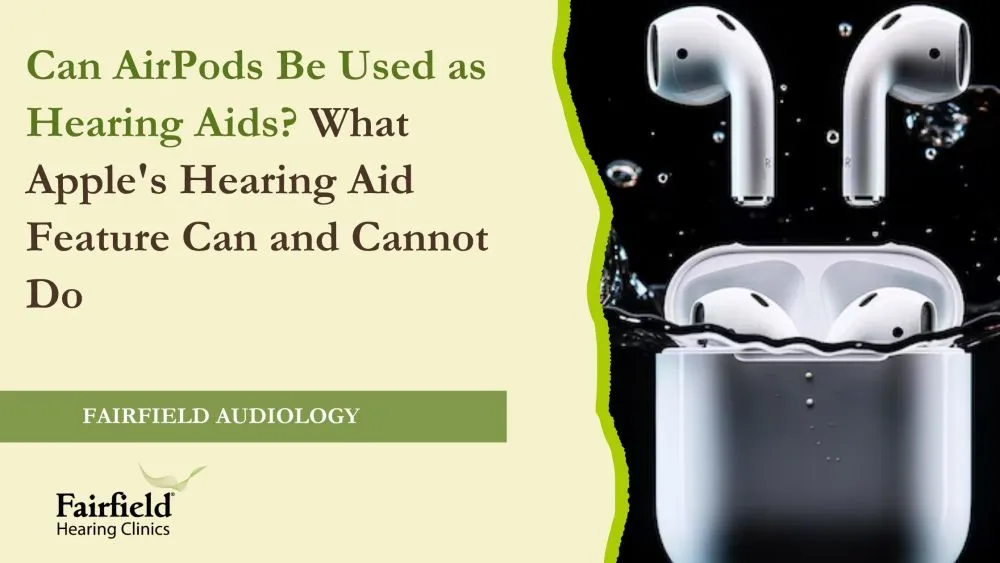
It is not a separate product. It is software built into recent AirPods Pro earbuds. There are three related tools:
A Hearing Test — a short, at-home check. Soft tones play in each ear, and you tap the screen when you hear them, a little like a test at a clinic [2][3].
A Hearing Aid feature — using your test results, the earbuds gently raise the sounds and voices you find hard to hear. You can adjust it yourself, without a professional [1][2].
Hearing protection — the earbuds can also reduce very loud sounds around you to help protect your ears [3].
What you need: AirPods Pro 2 or AirPods Pro 3, updated software, and a compatible iPhone or iPad running iOS 18 (or later). The hearing-aid mode is meant for adults aged 18 and over [1][2].
3. How it works, in simple steps
Update your AirPods Pro and iPhone to the latest software.
Take the built-in hearing test in a quiet room (it takes about five minutes).
The phone uses your results to set how much each sound is raised.
Wear the AirPods during conversations, TV or meetings, and adjust the volume to taste.
This “do-it-yourself” approach is what makes it easy and low-cost. It is also its main limit, because there is no professional checking that the settings truly match your ears.
4. Who it can help — and who it cannot
It may help you if
You are an adult with mild or moderate hearing difficulty.
You want a low-cost way to hear better in specific moments — a chat, a meeting, the television.
You already own AirPods Pro and want to try before visiting a clinic.
It is not suitable if
Your hearing loss is more than moderate (moderately-severe, severe or profound) — the earbuds cannot give enough power [4][5].
You need help all day, every day — battery life lasts only a few hours.
The user is a child — the feature is for adults 18 and older [1].
You have ear pain, discharge, sudden hearing loss, or hearing loss in only one ear — these need a doctor.
5. AirPods hearing feature vs professional hearing aids
Both can raise sound, but they are built for different jobs. This simple comparison shows the difference [4][5]:
| AirPods Hearing Aid feature | Professional hearing aids |
Who it's for | Adults 18+, mild–moderate loss | All ages, mild to profound loss |
Fitting | Self-fitting from a phone test | Fitted & fine-tuned by an audiologist, and verified |
Power | Limited (about half of a hearing aid) | Full range, including high power |
Daily wear | A few hours (battery) | All day, every day |
Extra help | Basic | Directional mics, feedback & noise control, custom fit |
Aftercare | None (you adjust it) | Ongoing support, service & re-tuning |
Medical check | No | Part of professional hearing care |
Comparison summarised from consumer and audiology reviews [4][5]. Exact numbers vary by model.
6. One important safety point: a phone test is a screen, not a diagnosis
The built-in hearing test is a helpful check, but it is not a full medical assessment. Hearing loss can have causes that a home test cannot find — such as ear wax, an infection, a hole in the eardrum, or, rarely, more serious problems. A hearing test in a clinic also checks the health of your ear, not just how loud you hear.
So please treat AirPods as a first check or a helper, not as a diagnosis. If your test shows a problem, or your hearing changes, see a qualified professional to find out why.
7. Is it available in India?
This is the most common question we hear locally, and the honest answer is: it depends on the date, because each country needs its own approvals. The feature has expanded to more than 100 countries. In India, however, the Hearing Aid feature has been limited and subject to local regulatory approval, and may not be fully available yet [3].
Because this can change over time, please check Apple's official India availability page for the current status before relying on it [3]. Whatever the status, a professional hearing test is always available to you at a clinic.
8. So, should you use it?
Here is our balanced, practical advice:
As a first step or a light helper for mild difficulty — it can be a reasonable, low-cost option if you already have AirPods Pro.
Get a professional hearing test if your difficulty is more than mild, is getting worse, is in one ear only, came on suddenly, or comes with pain or discharge.
For steady, all-day hearing — especially for older adults or anyone with more than moderate loss — properly fitted hearing aids remain the right choice.
Think of it as a bridge, not a destination. It can open the door to better hearing; a professional makes sure you walk all the way through.
9. Frequently asked questions
Can AirPods really work as hearing aids?
Yes. AirPods Pro 2 and Pro 3 have an FDA-authorized Hearing Aid feature for adults with mild-to-moderate hearing loss, but it has clear limits and is not a full replacement for hearing aids [1][2][4].
Are AirPods as good as real hearing aids?
No. They can help in some situations, but they have less power, no professional tuning, shorter wear time, and are only for up to moderate hearing loss [4][5].
Can children use the AirPods hearing aid feature?
No. The feature is intended for adults aged 18 and older [1].
Is the AirPods hearing aid feature available in India?
Availability varies by country and has been limited or pending in India. Please check Apple's official availability page for the current status [3].
Can it replace a hearing test at a clinic?
No. The built-in test is a useful screen, not a medical diagnosis. Some hearing loss has medical causes that only a professional can find [4].
Who should still see an audiologist?
Anyone with more than mild-to-moderate loss, one-sided or sudden loss, ear pain or discharge, and children or older adults with real hearing difficulty.
10. Conclusion
Apple's Hearing Aid feature is an exciting step. It has made millions of people think about their hearing, and for mild difficulty it can genuinely help. But it is a simple tool with real limits — not a replacement for a professional hearing test or for properly fitted hearing aids. Use it as a helpful first check, and let a qualified audiologist guide you the rest of the way. Better hearing is worth doing right.
Want to know your real hearing level? Book a free, professional hearing test with our RCI-certified audiologists — and get honest, expert advice. Call +91-9811418578 • www.fairfieldhearing.in • New Friends Colony, New Delhi |
Disclaimer (Medical, Legal & Trademark) This article is provided by Fairfield Hearing Clinics for general education and awareness only. It is not medical advice, a diagnosis, a prescription, or a recommendation to buy or use any particular product, brand or device. Product features, eligibility rules, and country availability described here can change at any time and differ by region. The information was believed to be broadly correct at the time of writing, but you should always confirm the current details from official sources before making any decision. A hearing test taken on a phone or earbuds is a screening check only and is not a medical diagnosis. Please do not rely on this article to diagnose or treat any condition, or to delay seeking care. For advice about your hearing or the right solution for you, consult a qualified, registered audiologist or an ENT physician who can examine you in person. If you have ear pain, discharge, sudden hearing loss, or hearing loss in one ear, seek prompt professional care. Trademark note: “Apple”, “AirPods” and related names are trademarks of Apple Inc. Fairfield Hearing Clinics is not affiliated with, authorised by, endorsed by, or sponsored by Apple Inc. or any other company mentioned. All product names and third-party sources are used only for identification, commentary and educational purposes, and their mention does not imply any endorsement. |
References & Credits
All information above has been summarised in our own words for easy reading. Full credit belongs to the original authors and publishers listed below. Readers are encouraged to consult the original sources for the latest details.
[1] U.S. Food and Drug Administration (FDA). “FDA Authorizes First Over-the-Counter Hearing Aid Software.” Press announcement, 2024. https://www.fda.gov/news-events/press-announcements/fda-authorizes-first-over-counter-hearing-aid-software
[2] Apple Support. “Use the Hearing Aid feature on your AirPods Pro 2 or AirPods Pro 3.” apple.com. https://support.apple.com/en-us/120992
[3] Apple (India) — AirPods Pro hearing health feature availability, and MacRumors coverage of the country-by-country rollout (check for the current India status). https://www.apple.com/in/airpods-pro/feature-availability/
[4] National Council on Aging (NCOA). “Can You Use AirPods as Hearing Aids? Review and Instructions.” ncoa.org. https://www.ncoa.org/product-resources/hearing-aids/airpods-as-hearing-aids/
[5] Audiology commentary comparing AirPods with prescription hearing aids (e.g., “AirPods Pro 2 vs. Hearing Aids: Clinical Comparison”, Audiology Island; “Why the New AirPods Pro 2 Won't Replace Hearing Aids”, Live Better Hearing). https://audiologyisland.com/blog/airods-pro-2-vs-hearing-aids/
© 2026 Fairfield Hearing Clinics, New Delhi. Prepared for public awareness. Please seek professional care for personal hearing decisions.