


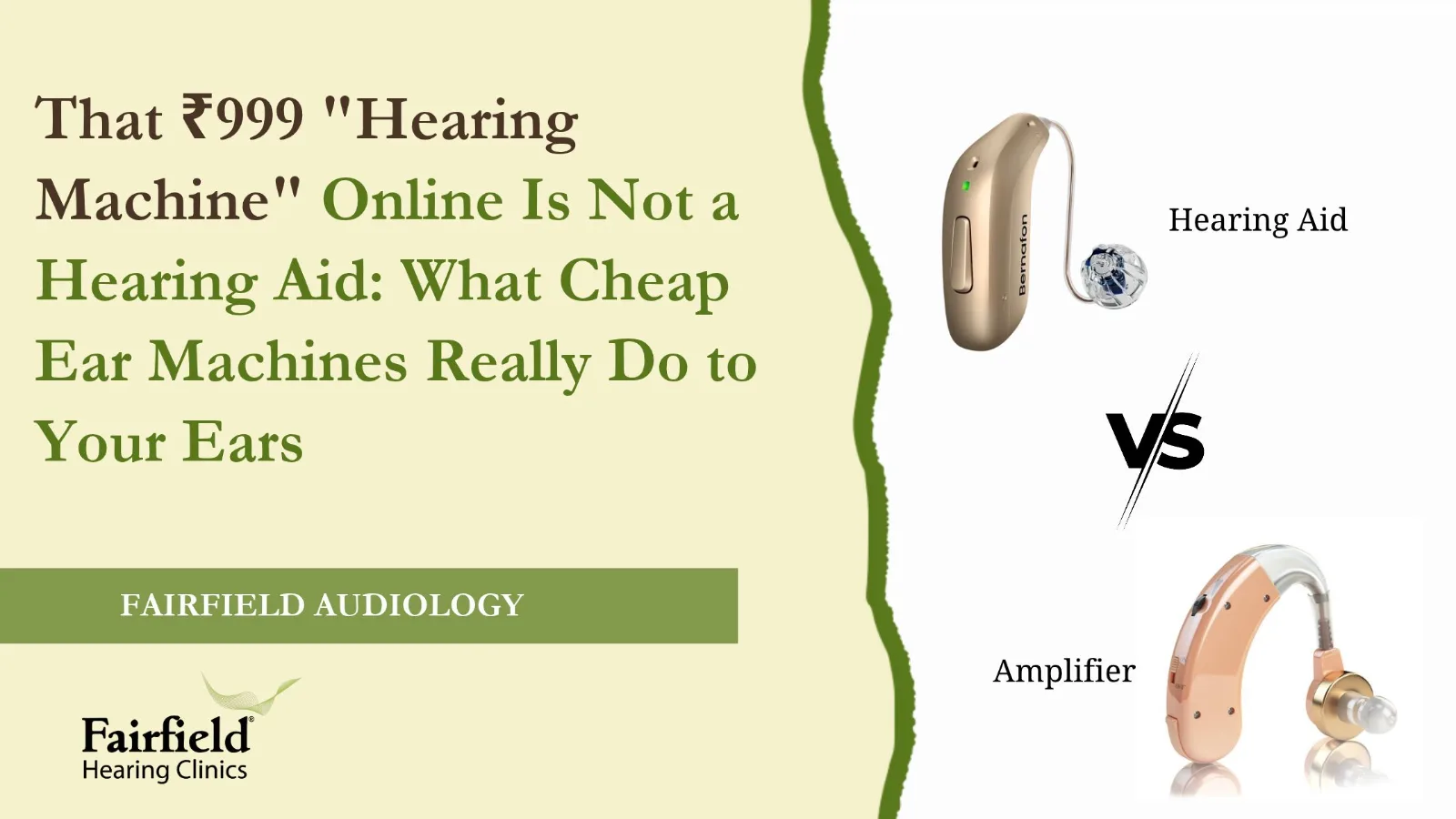
1. Is a cheap online hearing machine the same as a hearing aid?
No. Most cheap online "hearing machines" are personal sound amplifiers (PSAPs), which simply make everything louder; a hearing aid is a medical device programmed to your own hearing test. The two may look alike, but they are built for different jobs.
The US Food and Drug Administration (FDA) draws the line clearly: a PSAP is for people without hearing loss who want to hear better in some situations, such as birdwatching. If a product claims to help hearing loss, it is treated as a hearing aid and must follow hearing aid rules [2][6].
| Feature | Cheap sound amplifier | Prescription hearing aid |
|---|---|---|
| Who it is for | People with normal hearing wanting a boost | People with diagnosed hearing loss |
| Set to your hearing test | No - same for everyone | Yes - programmed to your audiogram |
| Which sounds get louder | Everything, often mostly low-pitched noise | Mainly the pitches you have lost |
| Volume safety limit | Often unknown | Set by your audiologist to your comfort level |
| Noise and whistle control | Little or none | Noise reduction and feedback control |
| Fitting and follow-up | None | Fitting, verification, adjustments |
| Regulation in India | Often sold as "amplifier" | Class B medical device; CDSCO licence |
2. How much do cheap hearing machines cost in India?
Online "hearing machines" in India are listed from about ₹259 to a few thousand rupees. During our research, listings on Amazon India ranged from ₹259 for a basic "kaan ki machine" to roughly ₹1,700–₹2,200 for rechargeable models, often shown against much higher "list prices" [1].
By comparison, prescription digital hearing aids from established brands in India usually start around ₹25,000 per ear and go up to several lakh rupees per ear for premium models, with fitting and follow-up included at most clinics. Our hearing aid price guide explains each price band.
Online prices change daily and "discounts" against an inflated list price are common. The figures above are what we saw at the time of writing, not quotations.
3. Do cheap hearing amplifiers actually work?
Some well-made amplifiers help people with mild-to-moderate loss in a quiet test room, but the cheapest ones often do not - and one even made hearing worse. The quality of the device matters far more than the label.
| Study | What it found | Type of evidence |
|---|---|---|
| Reed et al., JAMA 2017 - 5 amplifiers vs a hearing aid, 42 adults with mild-to-moderate loss | Hearing aid raised speech understanding in noise from 76.5% to 88.4%. Three amplifiers did nearly as well; one helped little; the cheapest (about US$30) scored 65% - worse than no device - due to distortion | Independent clinical study [3] |
| Chen et al., EClinicalMedicine 2022 - review of 5 studies, 124 patients | No significant difference between amplifiers and hearing aids overall, but the authors warned the studies were small, low quality and at high risk of bias | Systematic review [4] |
| International Journal of Audiology review, 2024 | Premium amplifiers improved speech in noise; basic amplifiers and smartphone apps did not | Systematic review [4] |
| J Speech Lang Hear Res, 2026 - review of randomised trials | Hearing aids gave substantially more benefit on patients' own ratings than amplifiers and other alternatives | Meta-analysis of RCTs [4] |
| Manchaiah et al., 2017 review | Low-cost devices were typically poor in sound quality and did not give enough high-pitch gain for age-related hearing loss | Narrative review [5] |
Two important limits of the research: almost all studies tested people with mild-to-moderate loss in quiet sound booths, not real Indian homes, markets and weddings. And the devices tested were mostly better-quality products than the cheapest unbranded machines sold online in India.
4. Can a cheap hearing machine damage my hearing?
Yes, it can, if it produces very loud sound and has no reliable safety limit. A 2017 review found that while some amplifiers met hearing aid standards, others produced dangerous output levels above 120 dB SPL [5].
For comparison, when the US created over-the-counter hearing aids in 2022, it capped their maximum output at 111 dB SPL (117 dB SPL for devices with input-controlled compression) and required a user volume control - precisely to protect ears [6]. India has no separate over-the-counter hearing aid category, so a cheap amplifier's true maximum output is usually unknown.
Loudness damage: turning up a cheap device to hear speech also makes sudden sounds - pressure cookers, horns, utensils - very loud.
Wrong pitches: age-related loss mostly affects high pitches. Many cheap machines boost low-pitched noise most, so people turn the volume up further to catch words.
Ear-canal problems: poorly made ear tips can cause soreness or irritation; sharing devices can spread infection.
Masking a medical problem: using a machine to cover sudden or one-sided loss can delay treatment that only works if started early.
5. Are cheap hearing machines legal in India?
A device sold as a hearing aid in India must be licensed, because hearing aids are classified as Class B medical devices under the Medical Devices Rules, 2017 [7][8]. Licensing for Class A and B devices was brought into force from October 2022, with transitional extensions for imports [7].
Many cheap products avoid the word "hearing aid" and call themselves "amplifiers" or "ear machines", or carry vague claims such as "audiologist designed". A marketing claim is not a licence and not a fitting. If a seller calls the product a hearing aid, you can ask for its CDSCO import licence (Form MD-15) or manufacturing licence number [8].
This section is general information, not legal advice. Regulatory rules and deadlines can change; check the official CDSCO website for the current position.
6. What can a real hearing aid do that a cheap machine cannot?
A hearing aid is fitted to your ears and your hearing test; a cheap machine is not fitted at all. That one difference explains most of the gap in comfort and clarity.
| Hearing aid feature | Why it matters |
|---|---|
| Programmed to your audiogram | Boosts only the pitches you have lost, so speech becomes clear without everything being too loud |
| Multiple channels | Different amounts of boost for different pitches - essential for sloping, age-related loss |
| Feedback cancellation | Stops the whistling that cheap devices often make when you hug someone or use the phone |
| Noise reduction and directional microphones | Helps you follow speech in groups, traffic and restaurants |
| Safety limit set by an audiologist | Loud sounds are kept below your discomfort level |
| Verification (real-ear measurement) | Checks what the hearing aid actually delivers inside your ear |
| Warranty, service and re-tuning | Hearing changes over time; the hearing aid can be adjusted instead of replaced |
7. Is a cheap sound amplifier ever a reasonable choice?
A good-quality amplifier can be a short-term stop-gap for an adult with mild, already-diagnosed hearing loss who has been checked by a doctor - but it is not a treatment for hearing loss. It should never be used for children, for sudden or one-sided loss, or as a way to avoid a hearing test.
If you do use one while you arrange a proper fitting, keep the volume as low as possible, stop if you get ear pain, ringing or discomfort, and do not share ear tips.
8. When should I see a doctor before buying any hearing device?
See an ENT doctor first if your hearing dropped suddenly, if only one ear is affected, or if you have ear pain, discharge, dizziness or new ringing. These can be signs of conditions that need medical treatment, not amplification.
Sudden hearing loss in one or both ears - treat as urgent and see an ENT doctor within days [9].
Hearing loss or ringing in only one ear, or a big difference between ears [9].
Fluid, pus or blood from the ear, or ear pain [9].
Dizziness or spinning with hearing loss [9].
A blocked feeling that may be ear wax - often fixed by safe wax removal.
Any child with suspected hearing loss - children need a full paediatric assessment, never an amplifier.
9. What is the hidden cost of using a cheap hearing machine?
The biggest hidden cost is delay: months or years of struggling with a device that does not suit your hearing, before getting proper help. Untreated hearing loss is linked with social isolation, and the 2024 Lancet Commission named hearing loss as one of the largest modifiable risk factors for dementia [12].
Repeat purchases when a cheap device breaks or whistles.
Lost confidence in hearing aids - many people conclude "hearing aids don't work" after a bad experience with an amplifier.
Missed conversations at home and work, and family frustration.
Possible further damage from over-loud sound (see question 4).
10. What are the affordable alternatives to a cheap hearing machine in India?
Affordable options include entry-level programmable hearing aids, CGHS reimbursement of up to ₹30,000 per ear, and the Government's ADIP scheme for low-income families. Many clinics, including ours, also offer a free hearing test and a trial before purchase.
| Option | What it offers |
|---|---|
| Entry-level digital hearing aid | Programmed to your hearing test by an audiologist, with warranty and follow-up; usually from around ₹25,000 per ear |
| CGHS (Central Government scheme) | Reimburses actual cost or ₹30,000 per ear, whichever is lower (up to ₹60,000 for both ears); device must be rechargeable with a 3-year warranty [10] |
| ADIP scheme (Government of India) | Full cost of an approved aid for monthly income up to ₹22,500; 50% for ₹22,501–₹30,000. Needs disability certificate/UDID, income proof and Aadhaar. The current scheme period ran to 31.03.2026 - check whether it has been extended [11] |
| Government hospitals | Hearing tests and, in some places, subsidised hearing aids |
| Exchange offers | Some clinics give a value for an old hearing aid against a new one |
Complete hearing aids attract nil GST in India, so check that no GST has been added to the price of the hearing aid itself.
11. How can I check whether a hearing device is genuine before I buy?
Ask five questions: Is it programmed to my hearing test? Who fits and adjusts it? What is the maximum output? Is it licensed by CDSCO? What warranty and service do I get? If the seller cannot answer, it is not a fitted hearing aid.
Hearing test first: a proper audiogram by an RCI-registered audiologist.
Brand and model: a recognised manufacturer with a model number you can look up.
Licence: CDSCO import or manufacturing licence number if sold as a hearing aid.
Programming: the device should connect to fitting software, not just have a volume wheel.
Warranty and service: written warranty, local service and follow-up visits.
Invoice: proper bill with serial number - also needed for CGHS or insurance claims.
If you are unsure about a device you have already bought, bring it to us - we will test your hearing and tell you honestly whether it suits you.
WhatsApp Us: Book a Proper Hearing Test →
Opens WhatsApp with your message ready · 9811551399 · Free hearing test
12. What else do patients ask about cheap hearing machines?
Is a hearing machine the same as a hearing aid?
No. Most cheap hearing machines sold online are sound amplifiers that make all sounds louder. A hearing aid is a medical device programmed to your hearing test by an audiologist.
Are ₹500–₹2,000 hearing machines safe?
Some may be harmless at low volume, but many have unknown maximum output. A 2017 review found some low-cost amplifiers produced dangerous levels above 120 dB SPL. Use of any device should follow a hearing test.
Can a cheap hearing amplifier make my hearing worse?
It can if it is used at high volume for long periods. In one JAMA study, the cheapest amplifier also made speech understanding worse than wearing nothing because of distortion.
Do I need a prescription to buy a hearing aid in India?
Hearing aids are fitted after a hearing test by an RCI-registered audiologist, and an ENT check is advised. India does not have a separate over-the-counter hearing aid category like the United States.
What is the cheapest proper hearing aid in India?
Entry-level programmable digital hearing aids from established brands usually start around ₹25,000 per ear. Government schemes such as ADIP and CGHS can reduce the cost for eligible people.
Can I use a cheap amplifier for my child?
No. A child with suspected hearing loss needs a full paediatric hearing assessment and properly fitted hearing aids, because hearing affects speech and language development.
What should I do if my hearing dropped suddenly?
Treat sudden hearing loss as urgent and see an ENT doctor within days. Do not try to manage it with an amplifier.
13. What is the bottom line?
A cheap online hearing machine is a sound amplifier, not a treatment for hearing loss - the best ones help a little, the worst can harm. Start with a hearing test; it costs little or nothing and tells you what you actually need.
If you do need a hearing aid, a properly fitted entry-level device, or help through CGHS or ADIP, is usually a far better use of money than a series of machines that sit in a drawer.
Get your hearing tested first
At Fairfield Hearing Clinics, RCI-registered audiologists test your hearing, explain the result in plain language, and show you options at every budget - including whether you need a hearing aid at all.
NFC Clinic: 139-A, Ground Floor, Chacha Complex, Taimoor Nagar Main Road, Near Meerabai Polytechnic, New Friends Colony, New Delhi 110025
Harinagar Clinic: Fairfield Hearing Clinics, shop no 2, wz,406-l-1, plot number 54, Janak Park, Hari Nagar, Delhi, 110064
WhatsApp / Phone: 9811551399 • www.fairfieldhearing.in
WhatsApp Us: Book a Proper Hearing Test →
Opens WhatsApp · 9811551399 · Free hearing test · No obligation
Important disclaimer
Please read this carefully
This article is for general knowledge and awareness only. It is not medical advice, a prescription, or a recommendation for or against any specific product. Please consult a physician, ENT doctor or qualified audiologist about your own hearing.
Online prices mentioned were observed at the time of writing and change frequently; they are not quotations. Research findings are summarised in plain language - please refer to the original studies for full details.
Regulatory and scheme information (CDSCO, CGHS, ADIP) is general information, not legal advice, and can change. Confirm the current position with the relevant authority.
This article is not paid for or sponsored by any company. All trademarks and brand names, including Amazon, belong to their respective owners.
If you have sudden hearing loss, ear pain, discharge, dizziness or new ringing, see a doctor promptly.
References
[1] Amazon India - hearing aid and hearing machine search listings (prices observed October 2026; retailer listings).
[2] US Food and Drug Administration. Hearing Aids and Personal Sound Amplification Products: What to Know (consumer update).
[3] Reed NS, Betz J, Kendig N, Korczak M, Lin FR. Personal sound amplification products vs a conventional hearing aid for speech understanding in noise. JAMA. 2017;318(1):89-90 (independent study).
[4] Chen CH, et al. Effectiveness of personal sound amplification products vs hearing aids: systematic review and meta-analysis. EClinicalMedicine. 2022;46:101378; with later reviews (Int J Audiol 2024; J Speech Lang Hear Res 2026).
[5] Manchaiah V, Taylor B, Dockens AL, et al. Applications of direct-to-consumer hearing devices for adults with hearing loss: a review. Clinical Interventions in Aging. 2017;12:859-871.
[6] American Academy of Otolaryngology-Head and Neck Surgery. Summary: FDA Over-the-Counter Hearing Aids Final Rule (2022) - 111 dB SPL output limit and PSAP guidance.
[7] Medical Dialogues. Class A and Class B non-notified medical devices must enter licensing regime (October 2022).
[8] Central Drugs Standard Control Organisation (CDSCO), Government of India - Medical Devices Rules, 2017 and SUGAM licensing portal.
[9] National Institute on Deafness and Other Communication Disorders (NIDCD). Over-the-Counter Hearing Aids - including warning signs that need a doctor.
[10] Ministry of Health & Family Welfare. CGHS Office Memorandum No. S.11030/76/2026-EHS dated 09-09-2026 (summarised in our CGHS guide).
[11] Department of Empowerment of Persons with Disabilities. ADIP Scheme (revised w.e.f. 26.09.2024) and ADIP FAQs.
[12] Livingston G, et al. Dementia prevention, intervention, and care: 2024 report of the Lancet standing Commission. The Lancet. 2024.